Case Study - Mastering user-centered design through surf lesson booking
A comprehensive learning project exploring user journey mapping and persona development through designing a surf school booking experience for first-time surfers in Los Angeles.
- Client
- Nazaré Mavericks
- Year
- Service
- User Journey Mapping, Persona Development, Information Architecture, Learning Project
Overview
Nazaré Mavericks began as a focused learning exercise: master the fundamentals of user-centered design by creating a realistic surf school booking experience. Rather than building another generic service website, we chose to explore the complex emotions and practical concerns of first-time surfers—a domain rich with anxiety, excitement, and practical barriers.
The project became a comprehensive exploration of UX research methodologies, from detailed persona development through complete journey mapping to information architecture design. We learned to think beyond features and focus on emotional states, pain points, and opportunity identification.
The learning objectives were clear: understand how to create evidence-based personas, map complete user journeys including emotional states, identify meaningful pain points and opportunities, and apply LATCH principles for intuitive information organization. Nazaré Mavericks provided the perfect canvas for practicing these essential UX skills.
What we learned
- User Journey Mapping
- Persona Development
- Pain Point Identification
- Opportunity Mapping
- Information Architecture
- LATCH Principles
- Touchpoint Analysis
- Emotional State Mapping
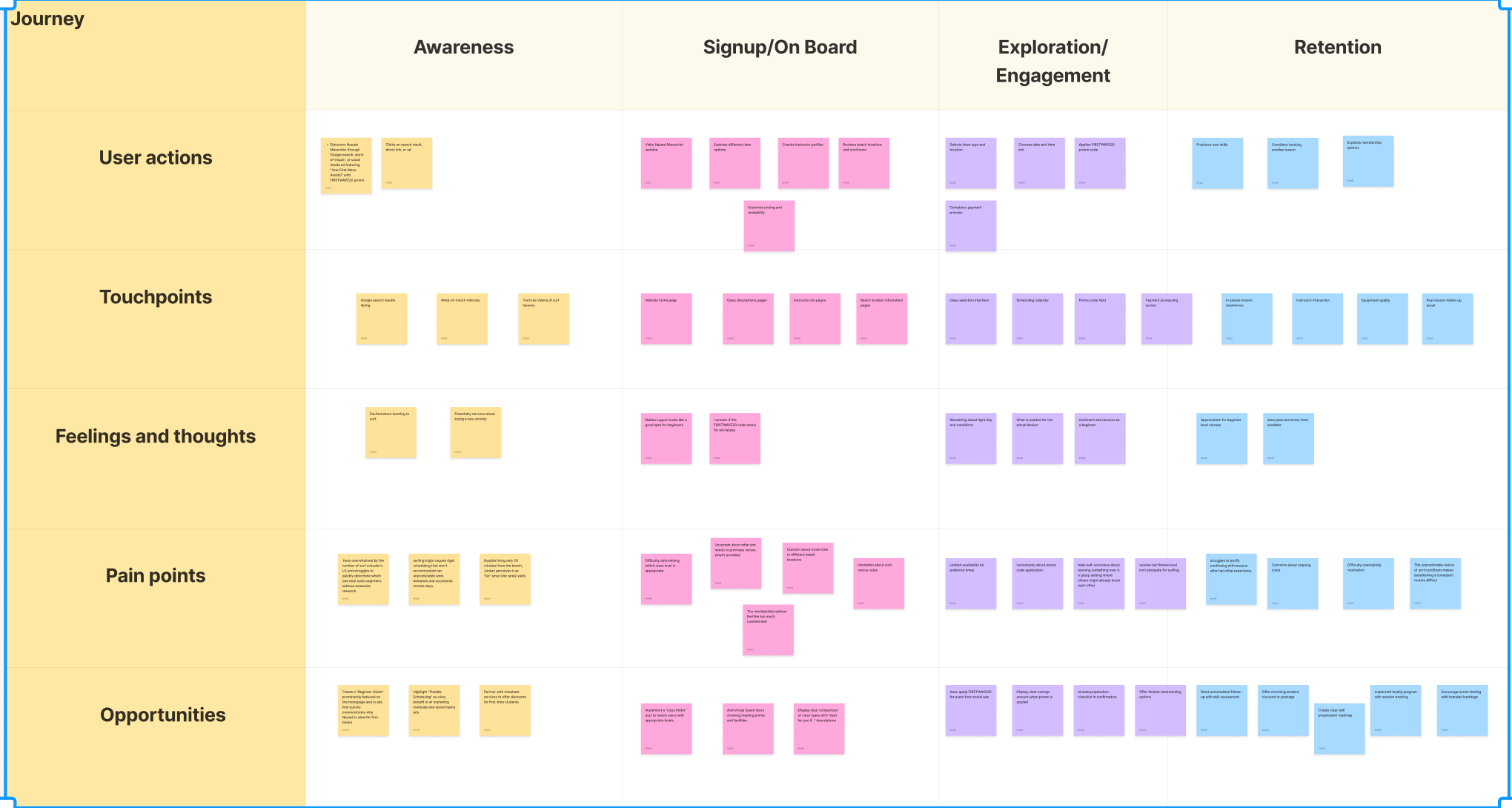
Persona Development: Meeting Jordan Reynolds
Creating Jordan Reynolds taught us that effective personas go beyond demographics to capture motivations, anxieties, and contextual challenges. Jordan wasn't just a "29-year-old marketing coordinator"—she was someone navigating the vulnerability of learning something new while adapting to life in a new city.
Jordan's profile revealed the importance of life stage context: recently relocated to LA, living 20 minutes from the beach but rarely visiting, working in a demanding tech environment with unpredictable schedules. These details weren't decorative—they directly informed design decisions about flexibility, scheduling, and barrier reduction.
The persona development process revealed how seemingly unrelated factors (work stress, social media following, transportation concerns) all influence user behavior in the surf lesson booking context. Jordan's story became our north star for evaluating every design decision.
Journey Mapping: From Awareness to Retention
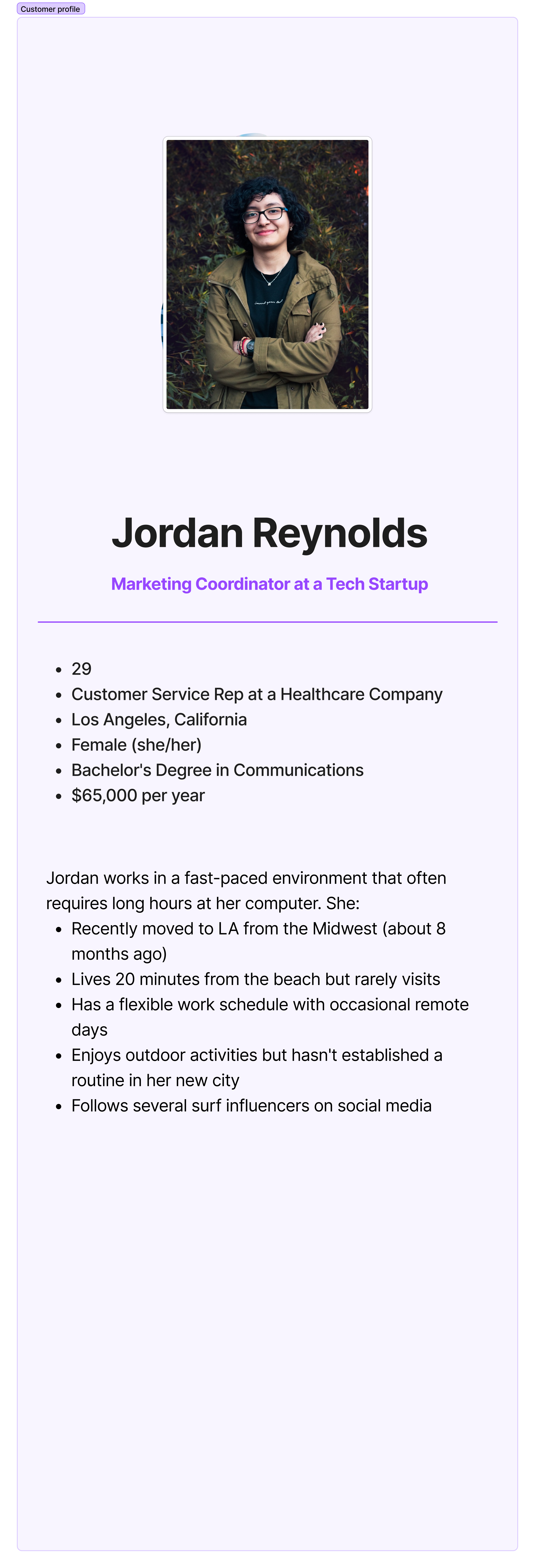
Mapping Jordan's complete journey from initial awareness through potential retention revealed the emotional complexity of service experiences. The awareness stage wasn't just about discovering Nazaré Mavericks—it was about Jordan's readiness to try something intimidating while feeling overwhelmed by choices.
The journey mapping process taught us to consider parallel emotional and practical tracks. While Jordan researched class options (practical), she simultaneously battled self-consciousness about fitness levels and group learning environments (emotional). Both tracks required design solutions.
Each journey stage revealed different needs: awareness required trust-building and beginner reassurance, signup needed simplicity and flexibility, engagement demanded confidence-building, and retention required motivation and progression clarity. This stage-by-stage analysis became fundamental to understanding user-centered design.
Pain Point Analysis: Beyond Surface Problems
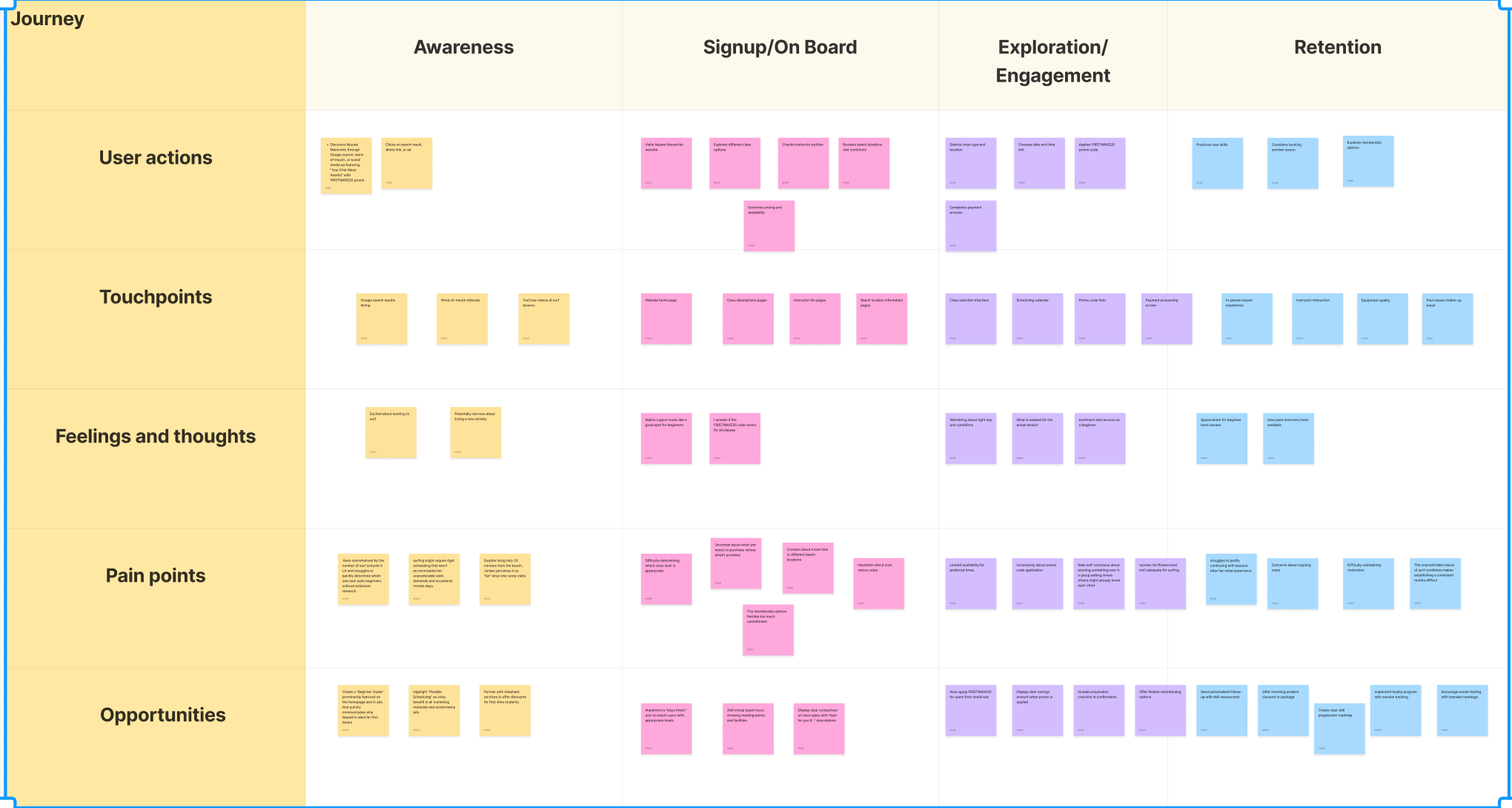
Identifying Jordan's pain points taught us to look beyond obvious usability issues to understand deeper psychological and contextual barriers. Her concern about "travel time to beach locations" wasn't really about distance—it was about unfamiliarity with LA beach culture and feeling like an outsider.
The pain point analysis revealed three categories: practical barriers (scheduling conflicts, equipment uncertainty), emotional barriers (self-consciousness, fitness concerns), and knowledge barriers (class level confusion, cost justification). Each category required different solution approaches.
Learning to distinguish between expressed pain points ("I don't know what equipment I need") and underlying concerns ("I'm worried about looking clueless in front of other people") proved crucial for developing meaningful solutions rather than surface-level fixes.

Touchpoint Mapping: Every Interaction Matters
Mapping Jordan's touchpoints revealed how many opportunities exist to build confidence and reduce anxiety throughout her experience. From Google search results to post-lesson follow-up emails, each interaction could either reinforce her decision or trigger doubts.
The touchpoint analysis taught us that pre-service interactions are often more influential than the service itself. Jordan's confidence about booking depended heavily on website content, instructor profiles, and clear preparation information—all before she ever touched a surfboard.
We learned to evaluate touchpoints not just for information delivery but for emotional impact. Does this instructor bio make Jordan feel welcomed or intimidated? Does the class description reduce anxiety or increase it? This emotional evaluation became central to UX thinking.
Opportunity Identification: Turning Pain into Gain
The opportunity mapping process taught us to systematically convert pain points into actionable design solutions. Jordan's overwhelm with "too many surf school choices" became an opportunity for a "Beginner Guide" that positioned Nazaré as the obvious choice for first-timers.
Learning to identify opportunities required understanding not just what frustrated users, but what would genuinely help them succeed. Jordan's scheduling anxiety led to flexible rescheduling options, but her deeper need for confidence building led to skill progression roadmaps and personalized follow-ups.
The most valuable lesson was recognizing that opportunities often address multiple pain points simultaneously. A clear preparation checklist reduces equipment anxiety, builds confidence, and demonstrates Nazaré's attention to beginner needs—solving three problems with one solution.
Information Architecture: LATCH in Practice
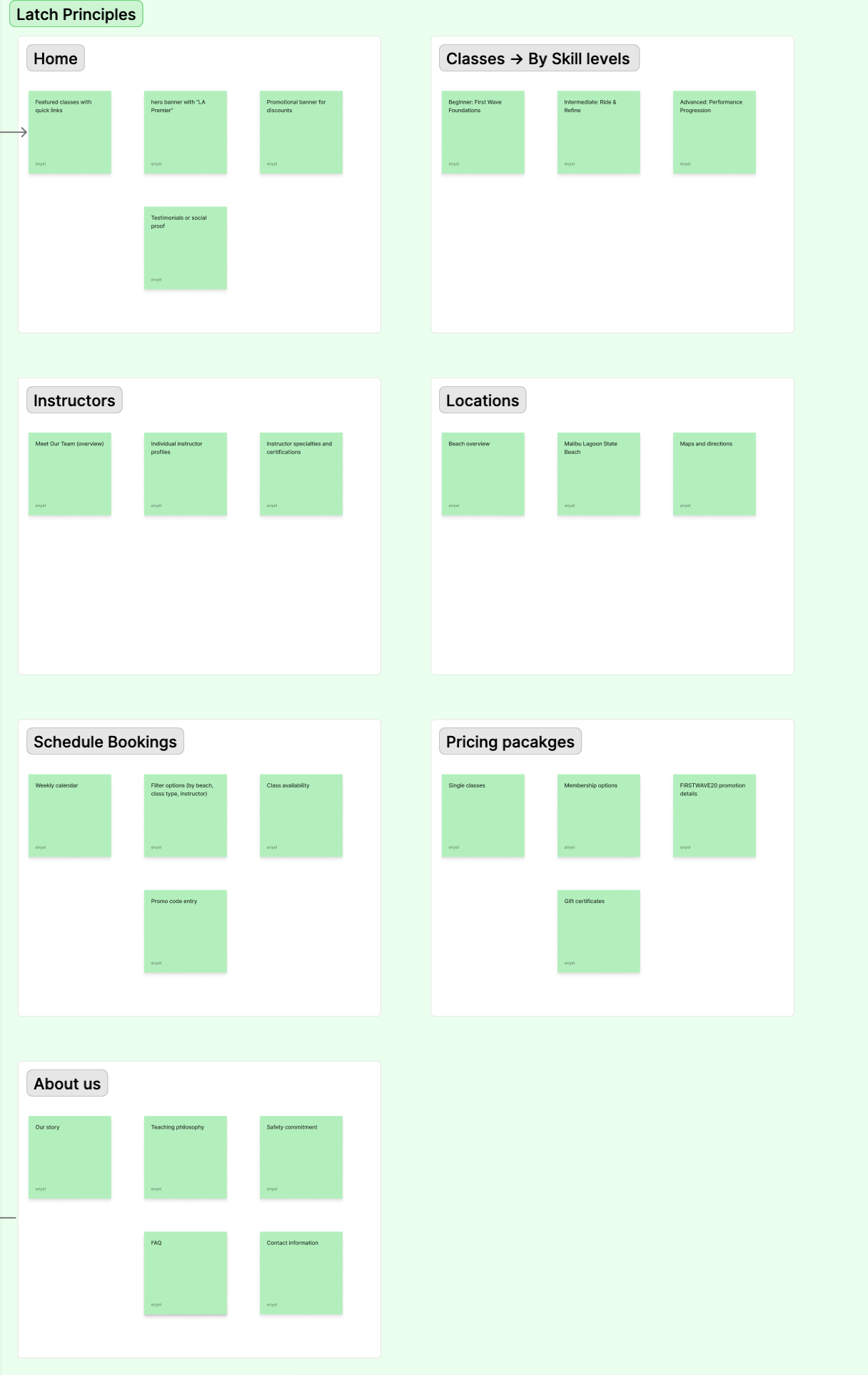
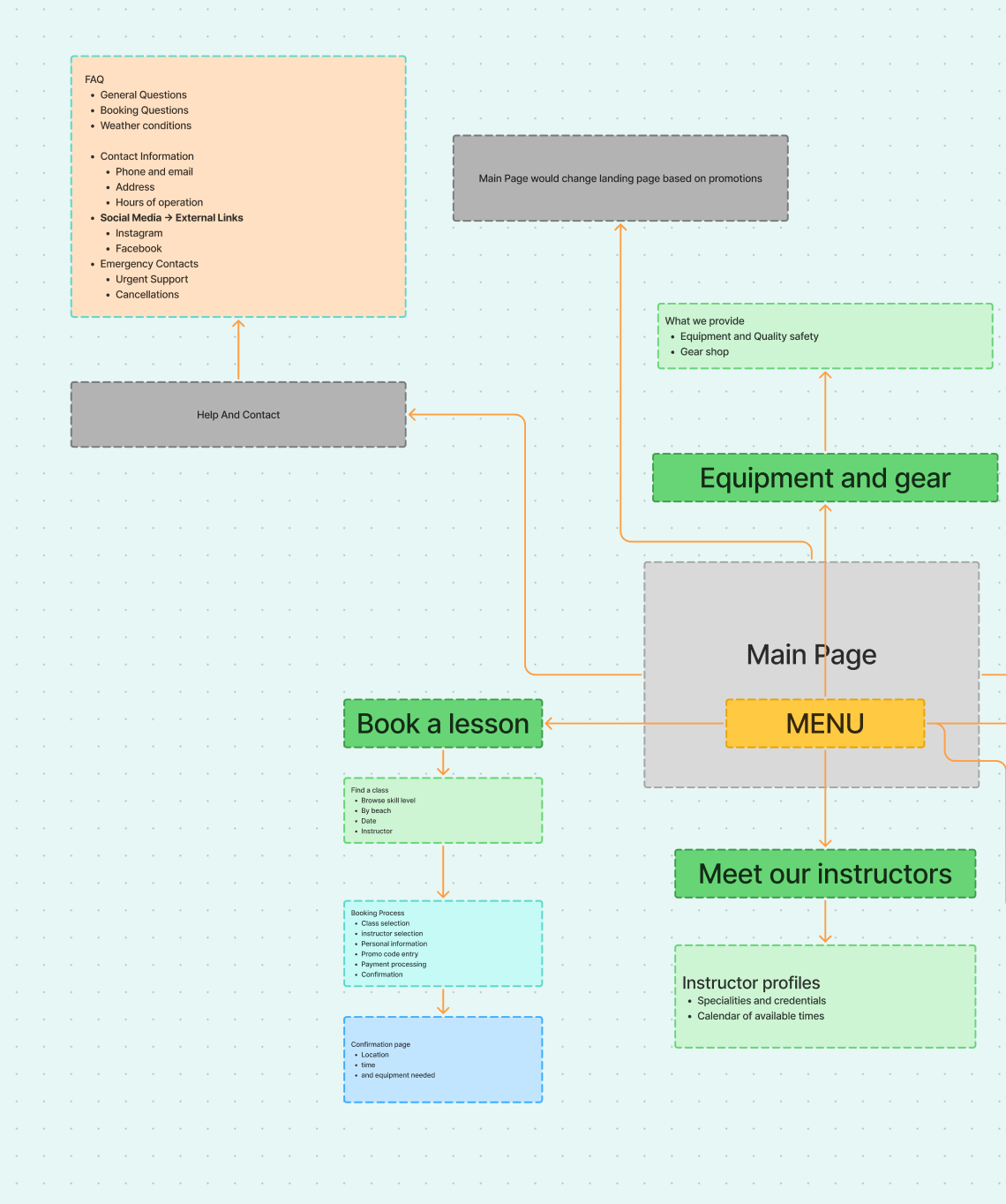
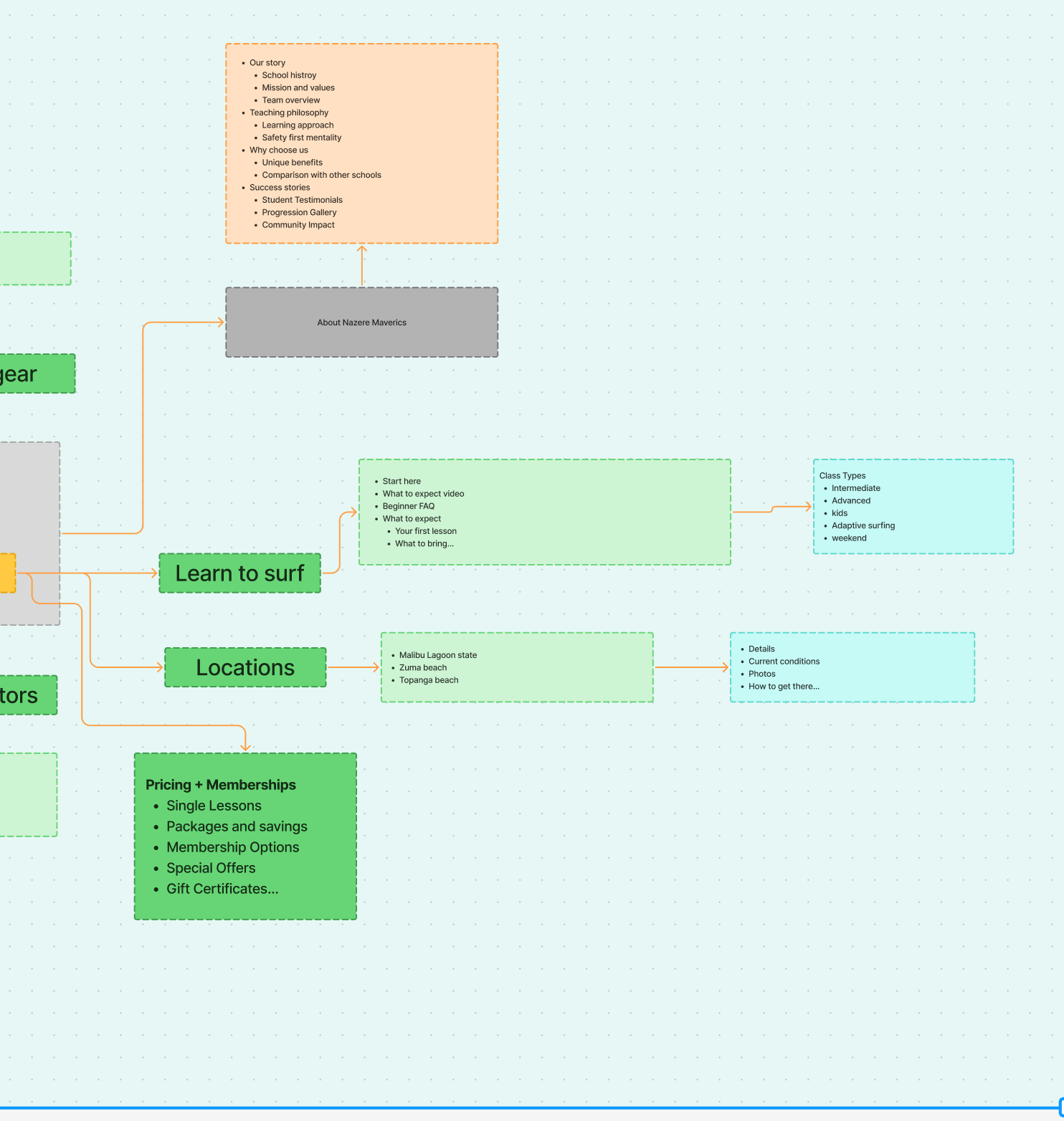
Applying LATCH principles (Location, Alphabet, Time, Category, Hierarchy) to Nazaré's content organization taught us how information structure directly impacts user confidence and decision-making speed. Jordan needed to quickly assess whether Nazaré suited her needs without extensive research.
The original information architecture scattered critical beginner information across multiple pages, forcing Jordan to hunt for reassurance. Reorganizing content by user priorities (beginner-friendliness first, then logistics) dramatically improved the evaluation experience.
LATCH principles helped us understand that information architecture isn't just about findability—it's about building user confidence through logical progression. Jordan needed to establish trust before considering logistics, require reassurance before commitment, and understand value before pricing.
Emotional Design: Beyond Functionality
Working on Jordan's journey revealed how emotional states drive user behavior more than rational considerations. Her excitement about learning to surf was constantly battling anxiety about being a beginner, and design needed to tip that balance toward confidence.
We learned that emotional design isn't about adding feelings to interfaces—it's about removing emotional barriers. Clear skill progression information didn't just provide logistics; it reduced Jordan's anxiety about long-term commitment and progress uncertainty.
The project taught us to design for emotional states, not just tasks. Jordan's pre-lesson nerves required different design solutions than her post-lesson excitement. Understanding these emotional contexts became essential for creating meaningful user experiences.
User-Centered Thinking: The Mindset Shift
Nazaré Mavericks fundamentally changed how we approach design problems. Instead of starting with business goals or technical constraints, we learned to begin with user needs and emotional contexts. Every feature decision was filtered through "Does this help Jordan feel more confident about booking and learning?"
The persona and journey mapping process taught us that user research isn't just data collection—it's empathy building. Understanding Jordan's Tuesday morning anxiety about fitness levels informed Saturday afternoon design decisions about class descriptions and preparation materials.
We learned that user-centered design requires constant advocacy for user needs, even when they conflict with business convenience or technical simplicity. Jordan's need for flexible scheduling mattered more than administrative efficiency.
Research Methods and Application
Creating Jordan's persona taught us systematic research thinking: combining demographic data with behavioral insights, emotional needs with practical constraints, and individual stories with broader market patterns. The persona became a research hypothesis that guided all subsequent design decisions.
Journey mapping revealed the importance of temporal thinking in UX design. Jordan's needs evolved from awareness through retention, requiring different solutions at different stages. This time-based perspective became fundamental to understanding user experience complexity.
The pain point and opportunity identification process taught us to think systematically about user problems. Rather than addressing symptoms, we learned to identify root causes and design holistic solutions that addressed multiple related concerns.
Key Learnings and Methodology Insights
Nazaré Mavericks transformed theoretical UX knowledge into practical design thinking skills. User personas aren't just demographic profiles—they're empathy tools that keep user needs central throughout design processes. Journey mapping isn't just workflow documentation—it's emotional archaeology that reveals hidden opportunities for experience improvement.
The project reinforced that good UX design addresses emotional needs as carefully as functional requirements. Jordan's anxiety about being judged mattered as much as her need for schedule flexibility. Both required thoughtful design solutions.
Most importantly, the project taught us that user-centered design is investigative work. Every design decision should be grounded in user research, validat